Upperville is full of ghosts. That is part of the charm of the place for me. You never know who you will see when you go out for an early-morning hack, or for a late–afternoon walk with a Labrador. There is a great sense of bustle in the countryside at those times, and the by-ways are crowded in memory. When the sun is just right, and burns off enough mist, you can catch a glimpse of a young George Washington crossing the Blue Ridge at Ashby’s Gap near Paris, Va. Tall, broad shouldered and even at sixteen showing the aura of command that would win a war in a few years. He won’t stop to talk with you, as he is in a hurry; the Northern Territories of Lord Fairfax await his surveyors’ tools.
I have always thought it was fitting that Washington should know so well the physical metes and bounds of the country that he would later help form and shape. He was one of the greatest of men, and I always tip my hat to him as he goes by. On the other hand, I smile when I pass my next-door neighbor, Capt. Adolphus E. (Dolly) Richards, CSA. He has never quite lived down being surprised in his bed at Green Garden by some thirty Union Cavalrymen during the Civil War. He successfully hid from them in the secret cupboard, and emerged half-dressed and enraged. They had embarrassed him and stolen his favorite horse. For a member of the 43rd Virginia (Mosby’s Rangers) this would never do.
He sprang onto the back of an old draft horse that the Union troopers had distained to steal, and took off after them. The troopers were headed back towards Berryville, oblivious to the hornet’s nest they had stirred behind them. Dolly Richards made haste to Upperville, where he organized a small group of fellow Rangers and beat the Union troopers to the top of Ashby Gap. As the Union cavalrymen sauntered up the road by the old church, Richards and his friends appeared from out of thin air and pitched into them at the curve in the road. Such was Mosby’s reputation at the time that a small band of his men could rout far superior numbers.
Dolly came by his own reputation fair and square. He was promoted by Gen. Lee himself to be Captain and Commanding Officer, Company B, 43rd Va. Cavalry in 1864 for “gallantry and skill displayed in action.” This was high praise indeed at a time when the art of leadership and command was to “lead from the front.” Given the lethal nature of war, then and now, this speaks well of his courage. (Brevet Gen. George A. Custer USA, although an egotistical imbecile, at least had either personal courage or foolhardiness, depending on the eye of the onlooker.)
At any rate, Richards and his band recaptured Dolly’s favorite charger plus an additional one hundred horses that had been destined for Union service, and gave the Union cavalry yet another black eye in the bargain. Napoleon said the moral to the physical was as three to one, but he never met Mosby and his Rangers, who routinely and successfully fought at a ten-to-one disadvantage. The numbers are a bit hard to determine with any exactitude, but Mosby probably commanded only about 800 men in total, and rarely took more than one hundred men with him on any of his raids. Yet by the end of the Civil War, Gens Grant and Sheridan had a Division, over 10,000 men, unsuccessfully devoted to suppressing Mosby’s depredations.
Mosby impresses me as the perfect model for a cavalryman. Thirty-eight when war broke out, he was 5’7”, and about 140 pounds. Most historians have refrained from the “little man with a chip on his shoulder” cliché; Mosby was average in size for his day. Many of his biographers refer to him as contrary minded and “a natural aginner” and in this they are correct. His photos show an active frame and an amused air of authority and arrogance on his lean face. His eyes tell his story, sharp and intensely focused, almost predatory. He showed an early penchant for sudden, aggressive action. As a 19-year old student at the University of Virginia, he shot a bully named George Turpin in the neck. His victim survived, and Mosby spent some months in the local jail for the “malicious shooting” of Turpin. He was never one to waste time. Mosby began his reading of law books during his incarceration, which led to his life-long career as an attorney.
If becoming a lawyer came to Mosby only after long and arduous study, he seemed to take to the study of war intuitively and instantly. He combined celerity of movement with audacity. Col. Taylor, speaking of Robert E. Lee after the Battle of Malvern, said “That man’s name might be audacity. He will take more chances quicker than any man you ever saw.” He could have said the same thing about Mosby.
Nowhere was this trait of Mosby’s on better display than early in the morning of March 9th, 1863. Brig. Gen. Edwin H. Stoughton had been put in charge of the Union cavalry in the Fairfax area, and instructed to put an end to Mosby’s depredations. Stoughton was an all-too typical General of the period. (A Union contemporary, Gen. Benjamin Butler, was given the nickname “Spoons” by his troops on occupation duty in New Orleans; no family’s silver was safe when Butler was about. After the war there would hardly be a Southern family of any repute that did not have a story told by an aunt, or grandmother, or spinster cousin, of finding their family silver for sale in New York, or Philadelphia, or even that hot-bed of abolition, Boston.)
Stoughton was viewed with suspicion by his superiors, who doubted his abilities, and universally loathed by his men for his spectacular disregard of their welfare. One of his men remarked that while Stoughton was supposed to be in charge, he could do little while his headquarters was six miles away from his troops. The soldier finished his letter by remarking that “it seems to me that a General should be with his men.” Stoughton might have saved his career, and considerable embarrassment, if he had listened to this private rather than the importuning of his mistress, Antonia Ford.
Mosby had put out a call for his men to meet him at Aldie, just west of Gilbert’s Corner on what we now refer to as Route 50. Twenty nine men showed up, and away they went, through Chantilly and Centerville, and on to Fairfax. Stoughton was sound asleep in his chambers, with several empty bottles of champagne bearing mute testimony to his inattention to his duties. Sometime after two o’clock in the morning, Mosby burst into the General’s bedroom, propelling Stoughton’s aide in front of him. The aide was thoroughly subdued because, as Mosby remarked “A six-shooter has great persuasive power.” The General slept on, until Mosby lifted the covers back and gave him a smack on his ample bottom. Thus galvanized, Stoughton joined nearly fifty of his men, now captives as well, and twice as many horses. Reputable historians gloss over the possibility that Stoughton was not alone in his bed, and Antonia Ford’s reputation was more or less spared.
The closeness of our history in this area is illustrated by one of the men that came along on the Stoughton raid, John DeButts. A century later, a relative of his by the same name built the lovely stone house that I can see from my back porch here north of Upperville.
Gathering his command, Mosby forced each prisoner to ride a captured horse, and to lead another, and thus they slipped away from Fairfax. Abraham Lincoln soon heard of this escapade and remarked, “Well, I am sorry to hear about that. I don’t care so much about the general. I can make another in five minutes. “ He paused for a minute, and then added “But I do hate to lose the horses.”
The horses were not all that Lincoln lost. Years later, Mosby would claim that during the Stoughton raid he captured an immense quantity of gold and valuables that the Union forces had seized. Being in a hurry to escape the aroused Union forces and meaning to return to it at a later time, Mosby buried the treasure about half-way between New Baltimore and Haymarket at two pine trees that he marked with an “X.” This story did not surface until Mosby was on his deathbed in late May of 1916, and to this day historians do not know what to make of it. Mosby said he was assisted solely by Sgt. James F. Ames. Ames was later captured at Rectortown and hung by Gen. George A. Custer near Front Royal. He died leaving no record of this escapade. Those looking for this treasure trove have had no success to date.
Another Union commander not having any better success in defeating Mosby was Col. John P. Taylor. Taylor had a squadron of Union cavalry in Warrenton about the time of Stoughton’s capture. One of his units was the 1st New Jersey and from that unit Trooper Aaron B. Tompkins wrote his mother in mid-January of 1864. His grammar and syntax are typical of the era, and I will reproduce it for you as faithfully as I can.
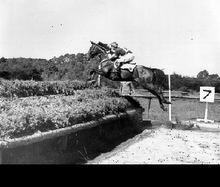
“the other day we was out on a scoute to a place that Mosby keeps him self I suppose that you know him when you see him fore you see him in the papers we get after him every once and a wile but he has got such good horses that we very seldom get eny one of them they have trained there horses to jump like a deer.”
Tompkins goes on to state that the NJ cavalry did capture two Rangers when their horses refused to jump. Quite right, too.
One of Mosby’s last raids occurred on October 14th, 1864, several miles west of Harper’s Ferry; an action we now refer to as the “Greenbacks raid.”. He and his men derailed a B & O train at about 3:00 in the morning. It was a bright and clear night, so the steam and glowing cinders from the wrecked locomotive made quite a spectacle. By now the Rangers were practiced at the art of relieving Union sympathizers of money and valuables, and they rapidly and thoroughly searched the passengers. “Stand and deliver,” one passenger was instructed. “Why, George, I am your brother,” was the reply, “and I have been robbed twice already.” The thoroughness of their examination paid off with the discovery that the B & O was carrying $173,000.00 in U. S. greenbacks.
This was a considerable sum in those days, given that Mosbys Rangers were paid 30.00 a month, in nearly worthless Confederate dollars. Leaving the train and rail cars to burn, Mosby led his men back over the Blue Ridge through the Snickersville Gap. Along the way, an officer of the German Army who had been captured came up to Mosby as they rode east in the dark. Noting his strange and glittering new uniform, Mosby made further inquiries. The German officer said that he had been along with the Union forces because he wanted to study the art of war. A short time later, the German officer was back, wearing obviously badly worn Confederate clothing, with his former fancy uniform nowhere to be found. The young officer complained bitterly to Mosby, stating that Mosby’s men had treated him roughly and stolen his uniform. Mosby roared with laughter, and said, “Well, you came over here to study the art of war, and this is your first lesson.”
Passing Bluemont, they camped at Ebeneezer Church, between Bloomfield and Airmont. With Dolly Richards and two other Rangers as paymasters, the command split the proceeds of the raid into equal portions, each of them taking home over $2,000.00. When I drive by the church on Greengarden Road, I always look off into the locust grove to the south and visualize the Rangers spread out before small campfires and telling stories on each other.
As was his practice throughout the war, Mosby refused his share and directed that it be paid to Ranger families in need. However, he later did accept the gift of a thoroughbred racehorse purchased for him by his men. An officer should certainly have his moral code in good working order during a time of war, and returning the greenbacks to his men was the right thing to do…but when it comes to the gift of a thoroughbred, what’s a cavalryman to do?
We know the answer to that last question, but these are enough tales for now. I enjoy writing these monographs, because I want people who know the Upperville area to have an understanding of just how close we are to history. Anyway, it is getting light in the Piedmont and it is time for my Labrador and I to go for a walk, while the campfires of Mosby’s Rangers still flicker in my memory.
540-592-3642
May 31-June 1, 2009
contact: Vanessa Morgan
vanessa@compfxnet.com
Woodside, CA
June 13-14th, 2009
contact:
Oregon House, CA
July 10-12th, 2009
contact: Karen Hisken
hisken@succeed.net